A Supportive Tool for Project Based Learning and Laboratory Based Education
Authors: Irwan Alnarus Kautsar¹, Riyanarto Sarno²
¹ Department of Informatics, Universitas Muhammadiyah Sidoarjo, Indonesia
² Department of Informatics, Institut Teknologi Sepuluh Nopember (ITS), Surabaya, Indonesia
Published in: International Journal on Advanced Science, Engineering and Information Technology (IJASEIT), Vol. 9 (2019) No. 2, pp. 630–639
ISSN: 2088-5334
DOI: 10.18517/ijaseit.9.2.7067
Link: https://ijaseit.insightsociety.org/index.php?option=com_content&view=article&id=9&Itemid=1&article_id=7067
Abstract
This paper presents the current development supportive tool for both lecturers and students that conduct Project Based Learning (PBL) and Lab Based Education (LBE) on Higher Education Institution (HEI). For PBL and LBE implementations, lecturer needs to monitor and evaluate the learning process. And students need to publish the learning outcomes in the public domain. In this research, we propose the supportive tool that will be used by lecturers who teach on different academic courses. Also, the proposed supportive tool is designed to be used by students as a particular group. These groups were formed of students from several academic courses supervised by the same lecturer. The developed supportive tool is microframework based, which means it could be implemented on mini devices. The developed supportive tool has been introduced to 135 students and 16 lecturers as participants to evaluate the system usability. The results from the questionnaire show more than 90% of users state the benefit of the supportive tool. Also from analyzing Log metric, users on average complete a designated task in just less than 5 minutes. It indicates that the developed supportive tool is easy to use and shows the effectiveness of the developed supportive tools.
Keywords: supportive tool; Project Based Learning; Laboratory Based Education; PBL; LBE
I. Introduction
With the era of the Industry 4.0 revolution, Higher Education Institutions have been challenged to provide experience to their students for having the skill and knowledge to solve world reality problems in a digital manner [1]–[4]. The need for skill and knowledge in the Industry 4.0 era is an ability to design a system to preserve vast amounts of data from digital products and make machines learn the future needs (automation) [5], [6].
The implementation of Project Based Learning (PBL) in an academic course could be a solution to give students experience working as a team and involving in IT projects or developing applications [7]. As a complement, Laboratory-Based Education implemented on most universities in Japan shows that shifting conventional academic courses (face to face) to peer teaching could increase research publications [8], [9].
From our previous research, we present Lecturer Based Supportive Tools (LBST) which enable lecturers to create learning content through a web-based application that can be accessed in online and offline conditions [10]. This paper proposes a supportive tool that supports lecturers to implement Project Based Learning (PBL) and Lab Based Education (LBE).
II. Material and Method
A. Project Based Learning
Project Based Learning (PBL) is a learning model that encourages students to solve real-world problems by applying knowledge and skills from academic courses [7], [9], [14]. For the PBL experience, we delivered an assignment to all students to make software with the topic: "A Software As Service for College Students." Students were also required to publish a final report, presentation, and poster according to the proposed software.
B. Laboratory Based Education
The goal of Laboratory-Based Education is to provide students with self-centered learning [8]. The idea is to give a student a laboratory environment where they can directly access and start research as soon as possible. The key in LBE is peer teaching. The faculty member only helps undergraduate students when there is a problem that could not be solved by postgraduate students.
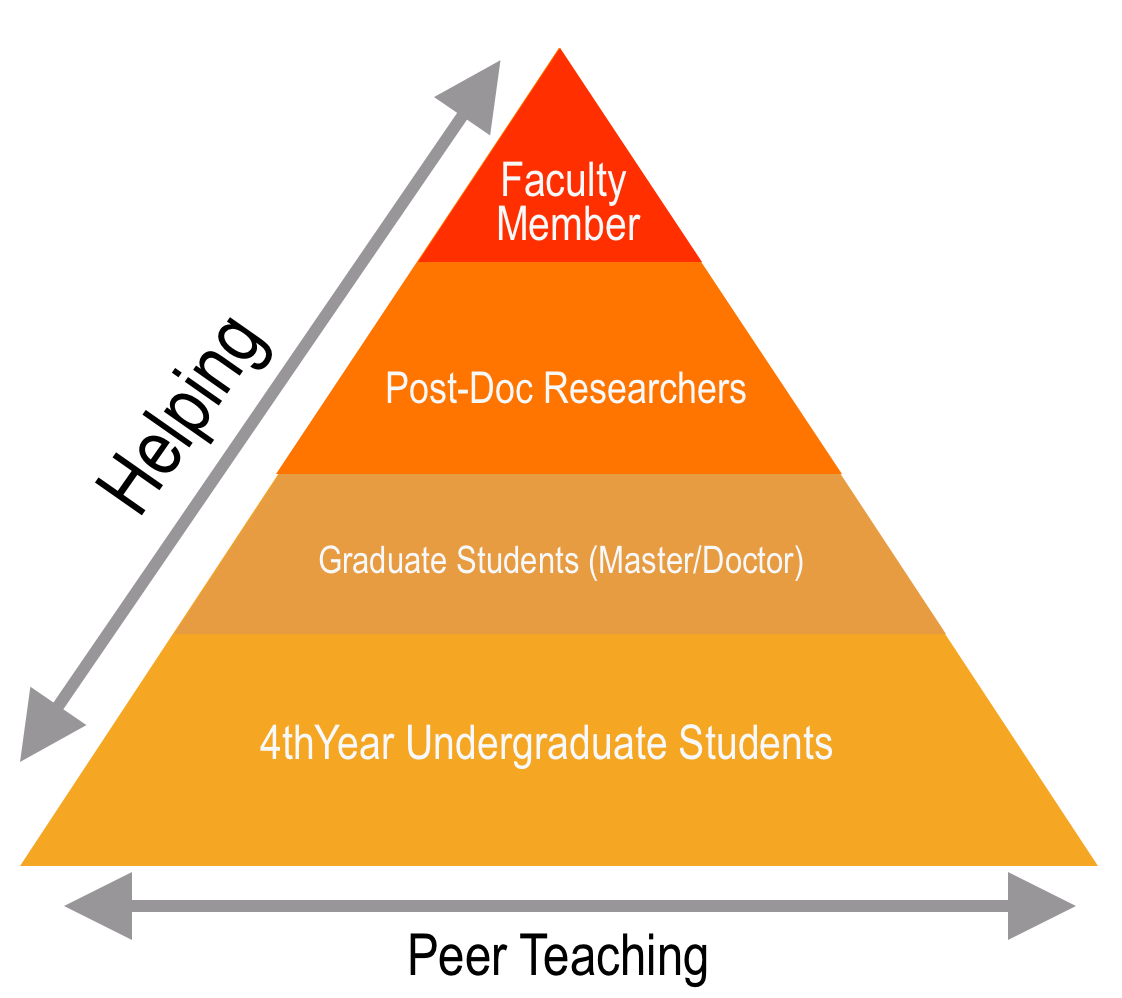 Fig. 1. LBE Pyramid of Peer Teaching
The undergraduate students, graduate students, and post-doctoral researchers learn together with their peers. A faculty member only helps/supervises when needed. LBE targets students to develop not only expertise in their fields but also soft skills such as communication, management, cooperativeness, and leadership.
C. Experimental Methods
The experiments were conducted at the Informatics Department, Faculty of Engineering, Universitas Muhammadiyah Sidoarjo in Academic Year 2017/2018.
Table I. Classroom Implementation for LBE and PBL Experiments
| Class Code | Class Name |
|---|---|
| HCI-8A3, HCI-8B4 | Human Computer Interaction (HCI) — 8th Semester |
| ADSI-6A1, ADSI-6A2 | Analysis and Design Information Systems (ADSI) — 6th Semester |
| SI-4A3, SI-4A4 | Information System (IS) — 4th Semester |
The task allocation across semesters: - 8th-semester students: develop UX/UI design (HCI course implementation) - 6th-semester students: design the complete diagram (ADSI course implementation) - 4th-semester students: software prototyping based on the UX/UI design and development diagram (IS course implementation)
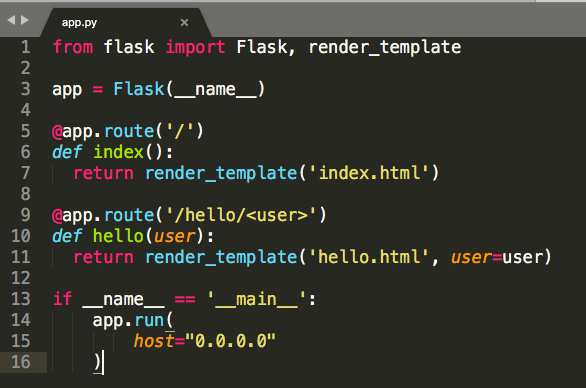 Fig. 2. Classroom implementation of LBE and PBL experiments
D. Development Method
In early-stage development, we implemented rapid prototyping using Google Design Sprint (GDS) [15]. To build the prototype, Flask Microframework was chosen [16]. As a Python-based microframework, the developed supportive tool could serve as a web server. By running a single Python script, it can run independently as a web application without being hosted at a web server. This means the lecturer could use the developed supportive tool directly with no need to install Apache/Nginx.
Flask adapts the MVC (Model-View-Controller) framework that separates the application layer and presentation layer. All database definitions (as a Model) and routing (as the Controller) are written in app.py. The static directory contains all static files, and the templates directory stores HTML files as the View.
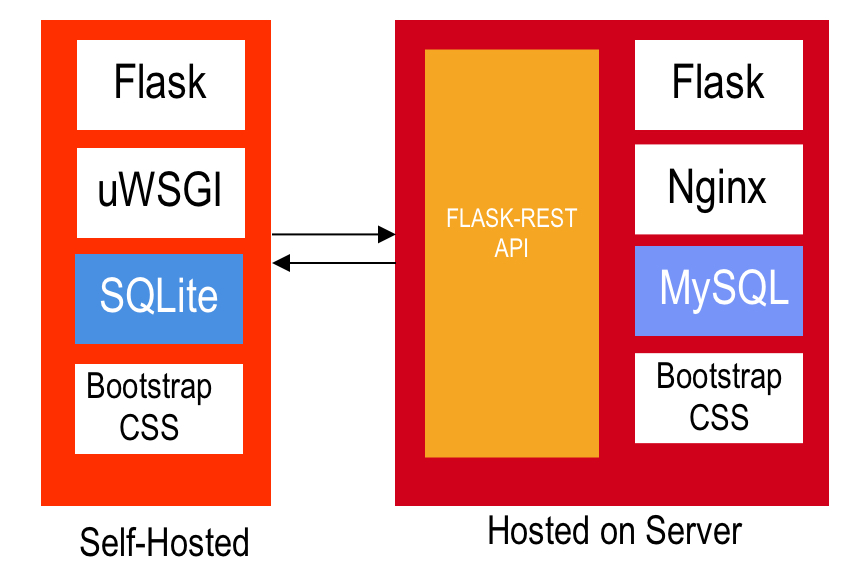 Fig. 3. WSGI server response
E. User Interactions
The prospective users for the developed supportive tool are lecturers, students as project managers, and students as team members.
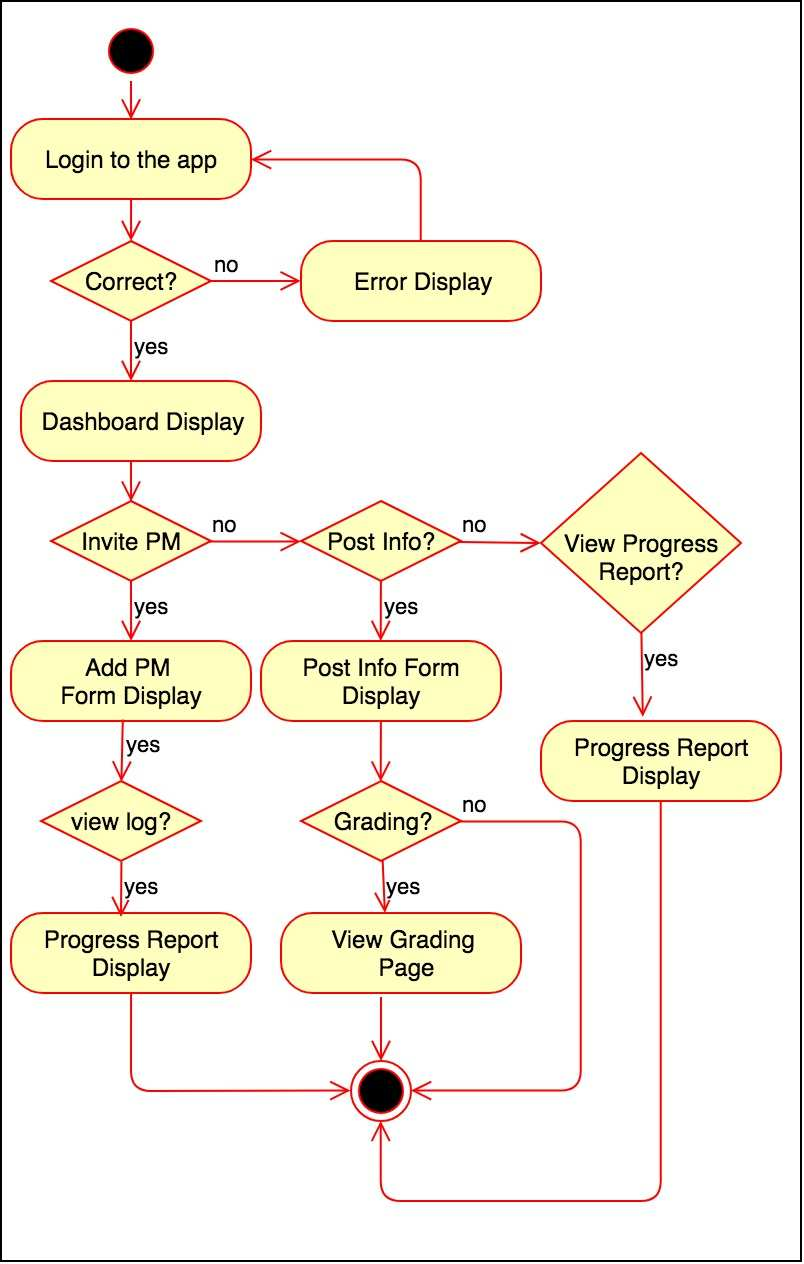 Fig. 4. User interaction diagram on the proposed supportive tool
III. Results and Discussion
A. Progress Report
The key success of PBL and LBE implementations is the lecturer's role in monitoring the learning process. The supportive tool provides a Progress Report Form where students are obligated to input every week.
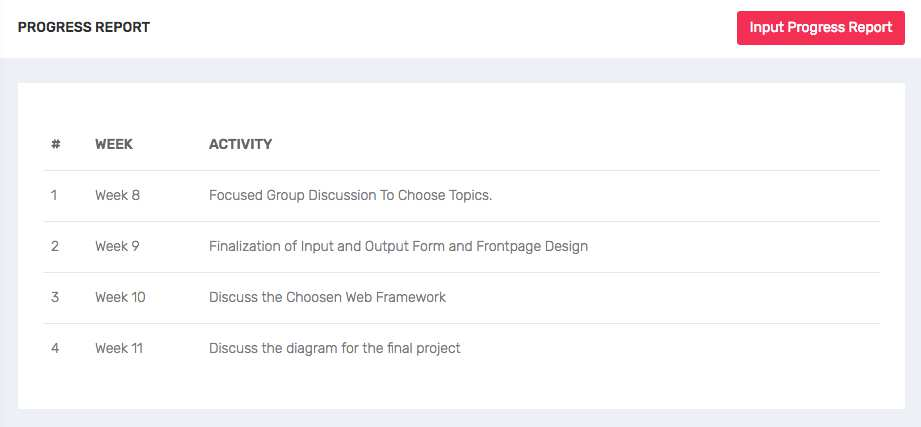 Fig. 5. Progress report inputted by students
B. Log Report
Lecturers are provided not only the progress report from each team but also the log information accessible by lecturers only. The log stores the URL address accessed, the timestamp, and the IP address. This helps lecturers analyze the learning process.
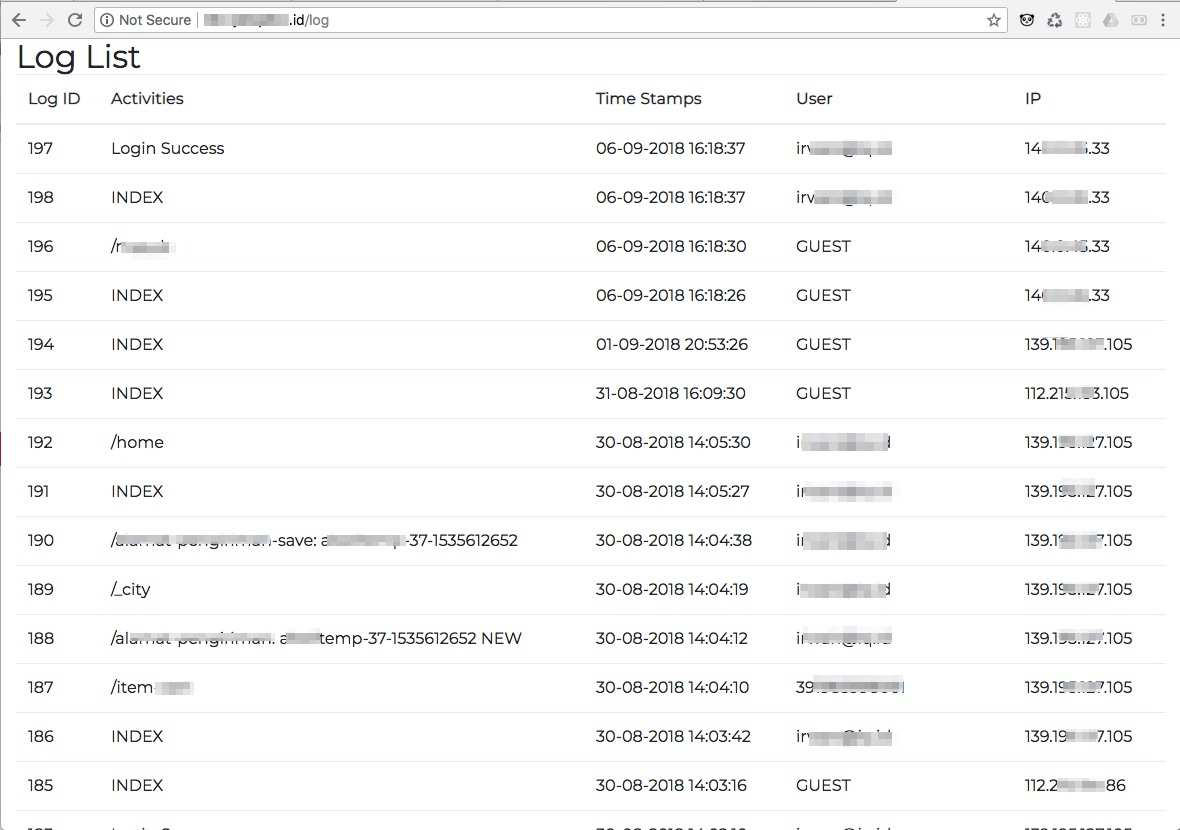 Fig. 6. Log of user activities
C. Project Publishing
As a result of Project Based Learning, students publish their final project in the public domain, inputting the project description and repository.
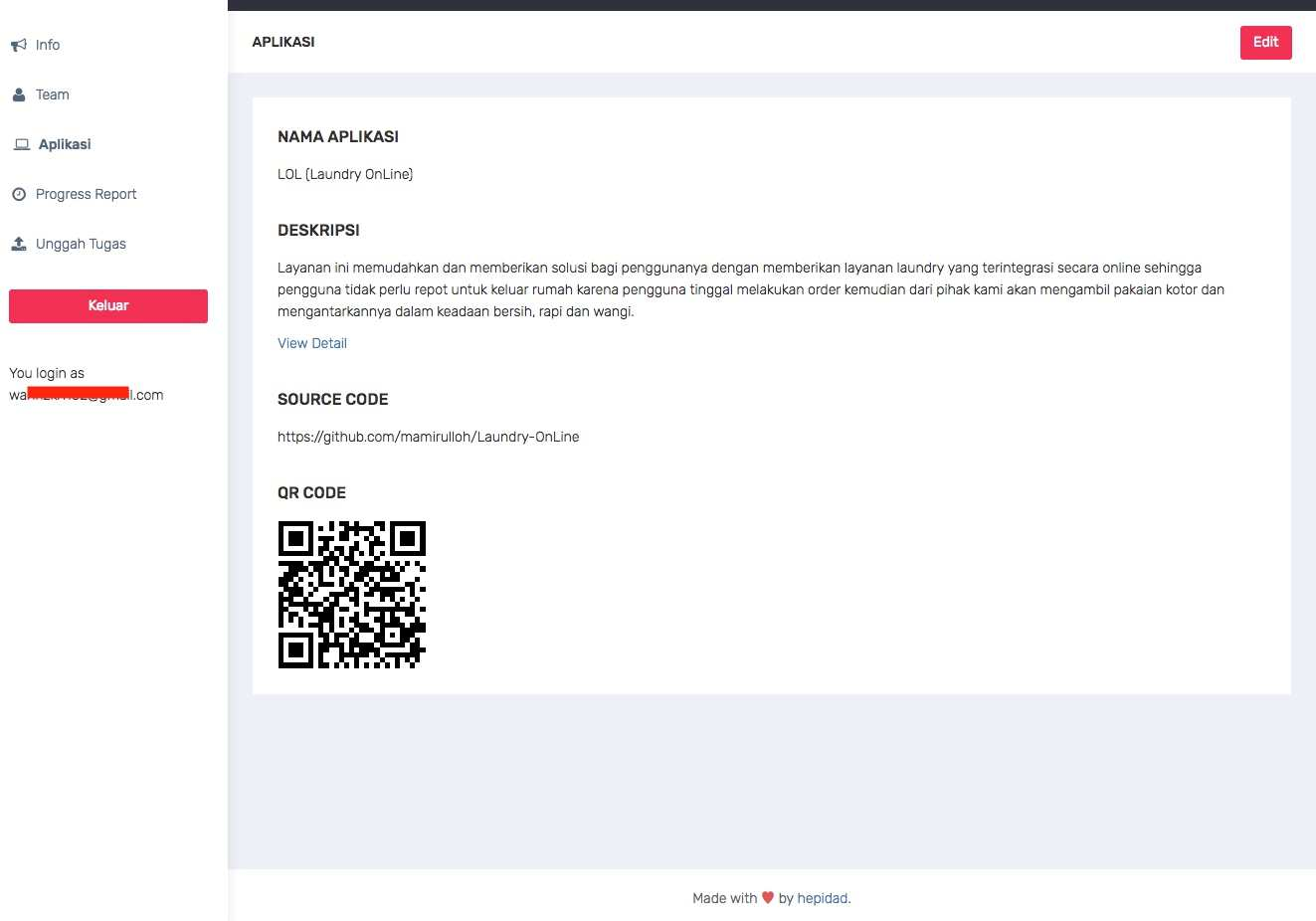 Fig. 7. Project description form
D. Supportive Tool Deployment
The use of a microframework brings advantages: the developed supportive tool application size is less than 20 MB. This makes it possible to deploy on a mini device (a hand-carried PC board that helps lecturer mobility across different classrooms). The supportive tool was deployed on an APC board connected to an access point.
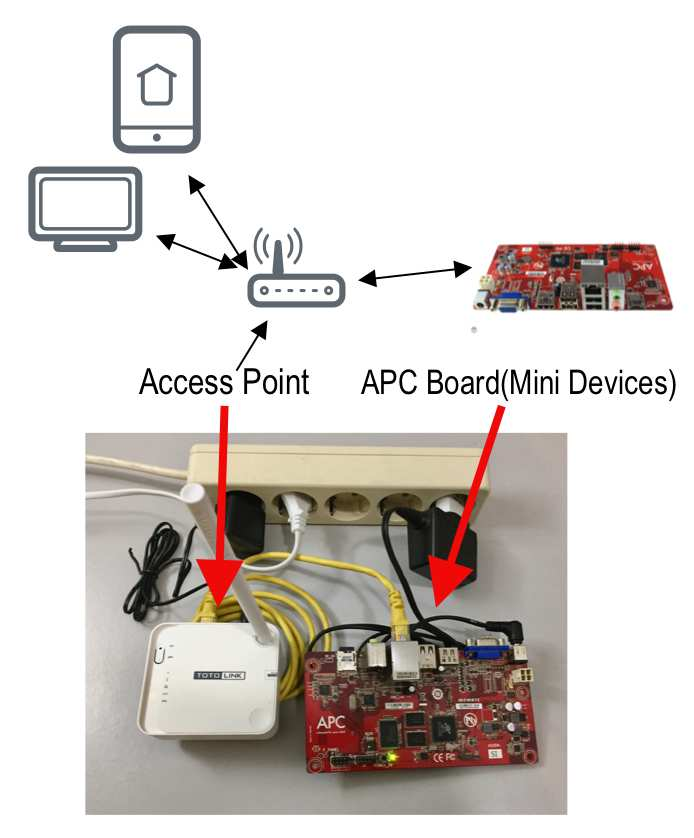 Fig. 8. Self-hosted deployment of developed supportive tool
To serve many requests on a mini device (Flask's default Werkzeug handler only serves development traffic), uWSGI is used as the request handler.
E. Results
The developed supportive tool was introduced to 135 students and 16 lecturers. Key findings:
- More than 90% of users state the benefit of the supportive tool
- Students on average need less than 4 minutes to accomplish each given task
- Lecturers on average need less than 3 minutes to finish each given task
- No tutorial was given before the experiments, yet all participants needed only a little time to accomplish tasks, indicating the tool is easy to use
IV. Conclusions
This paper presents a web-based application used by lecturers as a supportive tool for implementing Project Based Learning and Lab Based Education. Lecturers can monitor the learning process from progress reports inputted by students. Because each group consists of different class groups, lecturers only need to score a whole group rather than input scores manually per student.
The developed supportive tool can be used by students as an online portfolio to show their project. The tool offers a one-stop solution: lecturers no longer need to install a separate blog engine for announcements, an LMS to track progress reports and grading, and an ePortfolio to show student projects. All these features are provided in the developed supportive tool.
As a result of one academic semester experiment with 6 class groups, we obtained 32 particular groups with 32 particular web-based applications as their final project. This can be a useful repository for next year's students, both as a reference and as a hub to develop the final projects into production-level applications.
Acknowledgment
We would like to thank Direktorat Riset dan Pengabdian Masyarakat (DRPM), Direktorat Jenderal Penguatan Riset dan Pengembangan, Kementerian Riset, Teknologi, dan Pendidikan Tinggi for funding this research (Contract: E.6/026-09/22.00/PRY/II/2018).
References
[1] J. I. R. Molano et al., "Metamodel for integration of Internet of Things, Social Networks, the Cloud and Industry 4.0," J. Ambient Intell. Humaniz. Comput., vol. 9, no. 3, pp. 709–723, 2018.
[2] J. Y. Cho, "4th Industrial Revolution in Indonesia Through Cyber Education," Annual National Working Meeting 2018, Medan, Indonesia.
[3] A. Benešová and J. Tupa, "Requirements for Education and Qualification of People in Industry 4.0," Procedia Manuf., vol. 11, pp. 2195–2202, 2017.
[4] L. S. Dalenogare et al., "The expected contribution of Industry 4.0 technologies for industrial performance," Int. J. Prod. Econ., vol. 204, pp. 383–394, 2018.
[5] M. Wollschlaeger et al., "The Future of Industrial Communication," IEEE Ind. Electron. Mag., vol. 11, no. 1, pp. 17–27, 2017.
[6] B. Chen et al., "Smart Factory of Industry 4.0: Key Technologies, Application Case, and Challenges," IEEE Access, 2018.
[7] Project Based Learning references.
[8] Laboratory Based Education references (Japanese university model).
[9] Peer teaching and research publication studies.
[10] I. A. Kautsar et al., "Lecturer Based Supportive Tool Development and Approaches for Learning Material Sharing under Bandwidth Limitation," J. Inf. Process., vol. 24, no. 2, pp. 358–369, 2016.
[11] I. A. Kautsar et al., "Synchronizing learning material on Moodle and lecture based supportive tool: The REST based approach," in 2015 ICTS, pp. 187–192, 2015.
[14] PBL learning model references.
[15] J. Knapp et al., Sprint: How to Solve Big Problems and Test New Ideas in Just Five Days, Simon & Schuster, 2016.
[16] Flask Microframework documentation.
[17] Log-based metric usability evaluation references.
[19] Werkzeug WSGI documentation.
[20] uWSGI documentation.
(Full reference list available in the version of record.)
This is a preprint (author self-archived) version. The version of record is available at IJASEIT.