The use of User-centered Design Canvas for Rapid Prototyping
Authors: Irwan Alnarus Kautsar¹, M. Ruslianor Maika²
¹ Program Studi Informatika, Fakultas Sains dan Teknologi, Universitas Muhammadiyah Sidoarjo
² Program Studi Perbankan Syariah, Fakultas Agama Islam, Universitas Muhammadiyah Sidoarjo
Published in: Journal of Physics: Conference Series, Vol. 1764 (2021) 012175 (PVJ_ISComSET 2020), Bandung, Indonesia
DOI: 10.1088/1742-6596/1764/1/012175
URL: IOP Publishing
Note: This article is open access under the Creative Commons Attribution 3.0 licence.
Abstract
This paper presents the use of User-Centered Design Canvas to help students design the user experience (UX) on the designated Collaborative Projects. The Collaborative Project itself has been conducted by students with multi-discipline backgrounds. The User-Centered design itself was widely used as an approach to software development in order to achieve better alignment between the user experience and the business goal. Adopting Business Model Canvas, the User-Centered Design Canvas was introduced as an acceleration tool for rapid prototyping and ensures the effectiveness and efficient manner for the sake of user satisfaction. As the results from the questionnaire, more than 78% of users express the benefits of the current adaptation of User-Centered Design Canvas. Also from the Log Metric Analysis, users have completed a designated task under 5 minutes with minimum repetition. This indicates that the use of proposed adaptation is easy to use and shows the effectiveness of the User-Centered Design Canvas for rapid prototyping.
1. Introduction
In the year of Covid-19 pandemic in Indonesia, distance learning is the most suitable learning model for implementing social distance and self-quarantine [1], [2]. On the other hand, prototyping is one of the software development stages that deliver the early product [3]–[5]. For learning experience, prototyping is the most suitable option to help students implement their idea [6], [7]. Prototyping in software development is needed to know if the problem was feasible to solve technically or not [8], [9].
In this paper, we briefly discuss the use of User Centered Design Canvas to help students explore, plan and develop the user experience with proposed ideas. Also, how to implement the prototyping process using User Centered Design among students while conducting distance learning.
2. Proposed Method
In this paper we propose the use of User Centered Design Canvas to help students develop the user experience in their developed application as course assignment. Also we developed an extra feature from our developed supportive tool to help students adapt the User Centered Design Canvas while implementing distance learning.
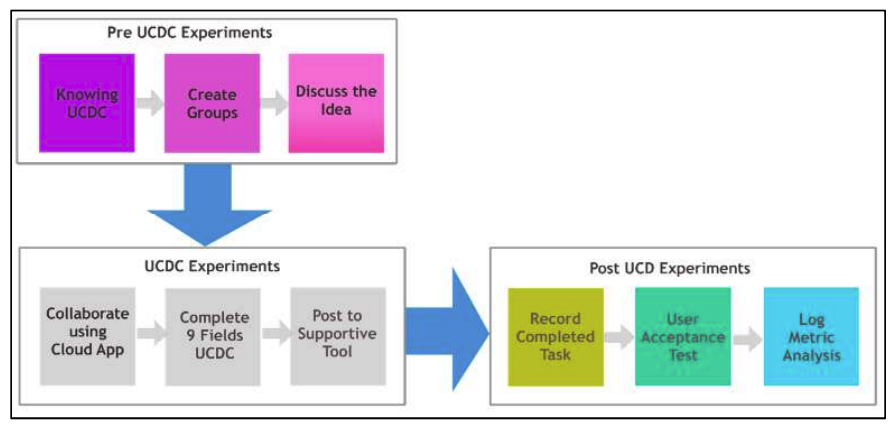 Figure 1. UCDC Experiments Method
2.1. User Centered Design Canvas
User Centered Design Canvas is a framework that is inspired by Business Model Canvas [10]. It was claimed the UX Tool combines user needs with the business goals [11]. By using UCDC, it will help UX designers to:
- Understand the targeted user and market needs
- Make a definition of product/market fit
- Align the business goal for the competitive advantages
- Define Unique Value Proposition as the brand communication strategy
Adapting the Business Model Canvas, UCDC is divided into 9 fields, starting with the user-centered approach until summarizing the Unique Value Proposition.
Table 1. UCDC Fields
| # | Field Name | Description |
|---|---|---|
| 1 | Business | Define Brand/Product name |
| 2 | Users | Define the potential/targeted users |
| 3 | Problems | Define the problem and how the proposed app solves the problems |
| 4 | Motives | Define user motivation that is willing to use the proposed app |
| 5 | Fears | Define user fears that would not use the proposed app |
| 6 | Solutions | Define existing solution from field 3 |
| 7 | Alternatives | Define the possible alternative app/solution that might be chosen by users instead of the proposed app |
| 8 | Competitive Advantage | Define the features or characteristics that differentiate the proposed app and competitors |
| 9 | Unique Value Proposition | Define the phrase that describes the value of the proposed app |
2.2. Cloud Application and Supportive Tool Extended Features
As part of this research, we developed extended features that will be used by students to collaborate designing the UX. For the collaboration, we use Cloud Application (Google Spreadsheet).
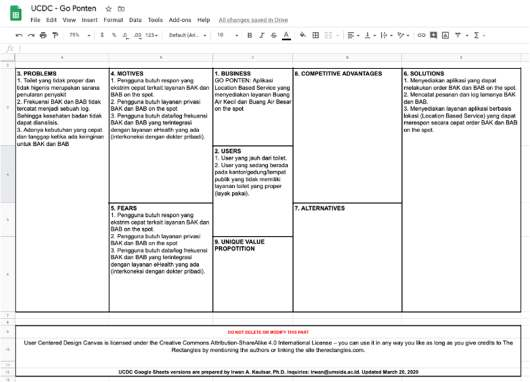 Figure 2. UCDC collaboration using cloud application
After each group completes the UCDC template at Google Sheet, each group is requested to post the final results to our current development Supportive Tools [12].
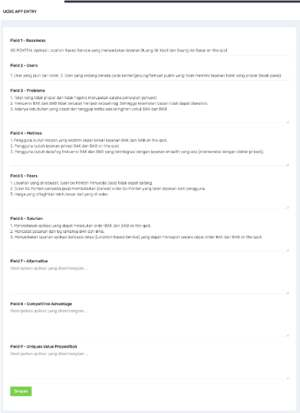 Figure 3. UCDC entry at developed Supportive Tools
2.3. User Responses
After explaining the use of UCDC at the beginning of the academic semester, students have been given the assignment to develop some apps that might be needed by higher education students. Students were requested to design the user experience of the proposed app using UCDC. We conducted questionnaires about the use of UCDC in several classrooms consisting of 168 students as participants. The students varied from 1st until 4th year bachelor degree.
The aim of the questionnaire was: (1) to determine the effectiveness of the proposed method for rapid prototyping, and (2) to evaluate our current development supportive tools.
3. Results and Discussions
3.1. Results
Before using or learning UCDC, all participants filled the designated questionnaire.
Table 2. Questionnaire for participants (pre-experiment)
| Questions | Yes (%) | No (%) |
|---|---|---|
| Have students ever created software? | 98 | 2 |
| Are students familiar with some prototyping tools? | 82 | 18 |
| Are students familiar with some UX-specific prototyping tools? | 74 | 36 |
| Do students ever design UX generally? | 12 | 88 |
| Do students ever learn or use UCDC? | 6 | 94 |
Next, a Likert scale was used to measure the perception from all participants using the formula [13], [14]:
$$P = \frac{N \times R}{I} \times 100\%$$
Where: P = percentage value of each question, N = value of each answer, R = answered value frequency, I = highest answered value × number of participants (5 × 168 = 840)
Table 3. Beta testing of the proposed method (post-experiment)
| Questions | Percentage (%) |
|---|---|
| Is the UCDC easy to use? | 81.5 |
| Is the use of UCDC more reasonable to define the UX Problems? | 77.4 |
| Does it help define the business value proposition? | 82.1 |
| Does it help define the problem solving? | 79.8 |
| Would students like to use UCDC for their next project? | 88.1 |
| Does UCDC help rapid prototyping? | 79.2 |
| Does the cloud application and supportive tool help collaboration in online conditions? | 82.7 |
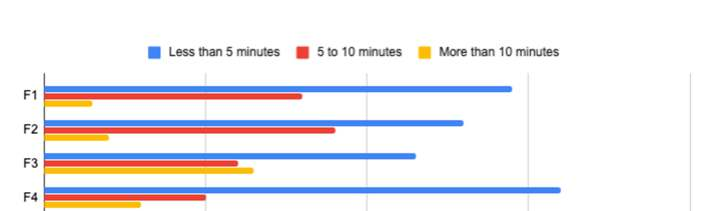 Figure 4. Accomplished Time using UCDC
3.2. Discussions
Based on the acceptance result, UCDC helps students do rapid prototyping. Furthermore, the use of existing cloud applications and supportive tools enable students to collaborate in online conditions. These learning models are suitable in the pandemic crisis, where physical distancing is needed. From this point of view, the use of UCDC is more practical to transform an idea into a real application. As part of the learning process, collaboration among each group member conducted in fully online conditions creates a new culture of creative process as a positive effect when the pandemic happened.
4. Conclusions and Future Works
User Centered Design Canvas (UCDC) helps do more rapid prototyping and define a more in-depth understanding about the basic need while designing User Experiences. Also, the use of cloud applications and supportive tools enable collaboration among students that implement distance learning during the pandemic era. For future works, it needs study to integrate the UCDC (for designing UX) with other prototyping tools for UI design.
References
[1] L. J. Faherty et al., "School and preparedness officials' perspectives on social distancing practices to reduce influenza transmission during a pandemic," Prev. Med. Rep., vol. 14, p. 100871, 2019.
[2] A. J. M. Júnior and H. F. Pauna, "Distance learning and telemedicine in the area of Otorhinolaryngology," Braz. J. Otorhinolaryngol., 2020.
[3] Q. Bao et al., "Interplay of sketching & prototyping in early stage product design," Int. J. Des. Creat. Innov., vol. 6, no. 3–4, pp. 146–168, 2018.
[4] D. Broderick et al., "The Use of Rapid Prototyping Facilitated by CAD-CAM Software in the Primary Management of Complex Zygomatic Fractures," J. Oral Maxillofac. Surg., vol. 77, no. 9, pp. e112–e113, 2019.
[5] C. A. Lauff et al., "The role of prototypes in communication between stakeholders," Des. Stud., vol. 66, pp. 1–34, 2020.
[6] J. G. Cooprider and J. C. Henderson, "Technology–Process Fit: Perspectives on Achieving Prototyping Effectiveness," J. Manag. Inf. Syst., vol. 7, no. 3, pp. 67–87, 1990.
[7] K. W. Jablokow et al., "Exploring the diversity of creative prototyping in a global online learning environment," Int. J. Des. Creat. Innov., vol. 8, no. 2, pp. 102–124, 2020.
[8] B. Westerlund and K. Wetter-Edman, "Dealing with wicked problems, in messy contexts, through prototyping," Des. J., vol. 20, no. sup1, pp. S886–S899, 2017.
[9] J. Knapp, J. Zeratsky, and B. Kowitz, Sprint: How to Solve Big Problems and Test New Ideas in Just Five Days, Simon & Schuster, 2016.
[10] "User Centered Design Canvas — First UX tool combining user needs with business goals," https://ucdc.therectangles.com
[11] T. Volkmann et al., "Historytelling: a Website for the Elderly, A Human-Centered Design Approach," in Proc. 9th Nordic Conf. HCI, pp. 1–6, 2016.
[12] I. A. Kautsar and R. Sarno, "A Supportive Tool for Project Based Learning and Laboratory Based Education," Int. J. Adv. Sci. Eng. Inf. Technol., vol. 9, no. 2, pp. 630–639, 2019.
[13] L. L. Keown and A. R. Hakstian, "Measures of Association for the Component Analysis of Likert Scale Data," J. Exp. Educ., vol. 41, no. 3, pp. 22–27, 1973.
[14] O. A. Ivanov et al., "Likert-scale questionnaires as an educational tool in teaching discrete mathematics," Int. J. Math. Educ. Sci. Technol., vol. 49, no. 7, pp. 1110–, 2018.
This article is open access (CC BY 3.0). The version of record is available at IOP Science.